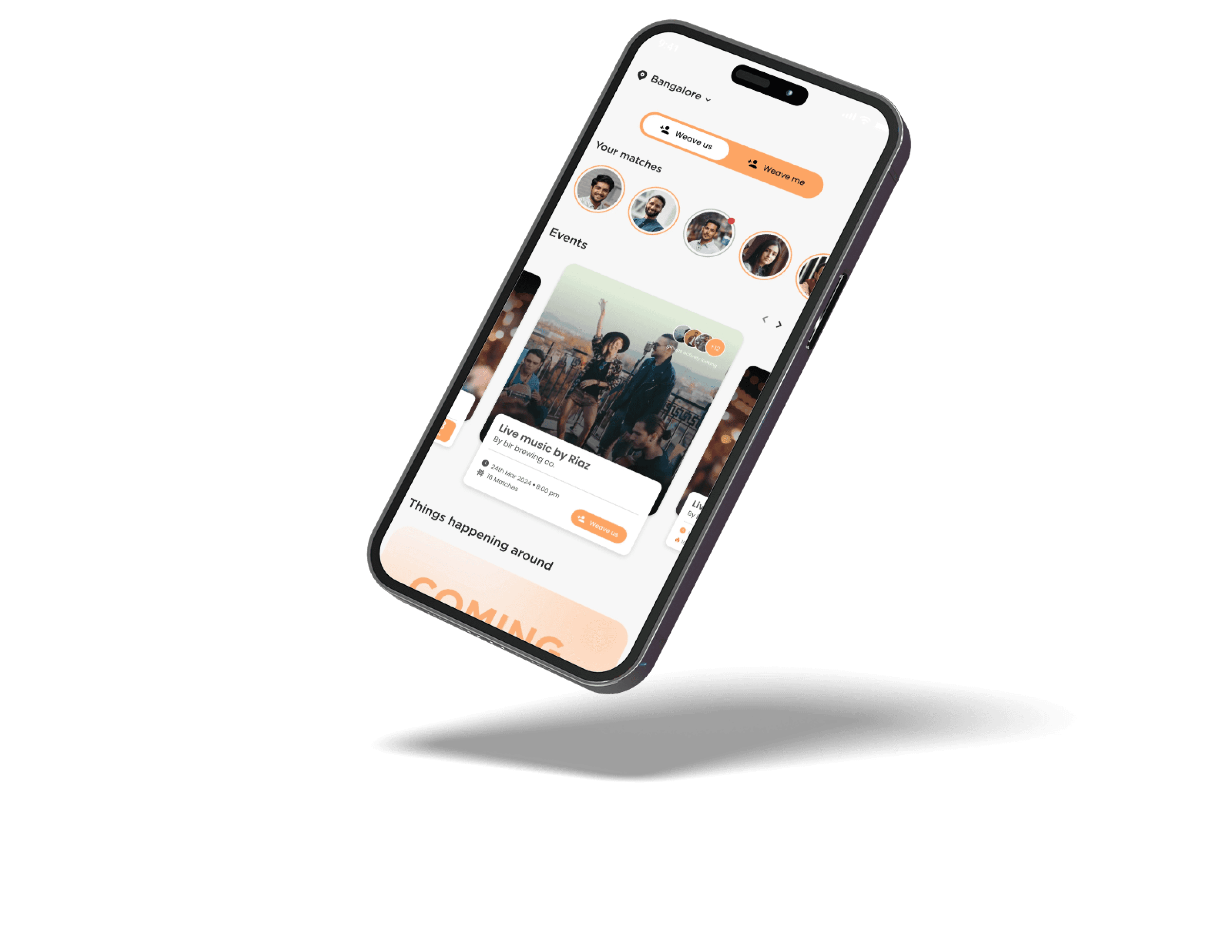

Weave
An app built for young people — solo or in groups — to find strangers heading to the same events nearby, and match before they even walk in the door, turning a night out into something worth sharing.
Gen Z
Target Audience
4
Months Duration
7
Research Phases
iOS & Android
My Role
Sole Designer,
Freelance
End-to-end ownership
across every phase.
Weave was a freelance engagement with full design ownership from initial brief to final handoff. There was no team — every decision, from how to frame the research questions to the last detail of the component library, was made and executed independently.
What distinguished the research process was how primary data was gathered. Rather than relying exclusively on interviews and surveys, real-world events — including a Holi celebration — were organised specifically to observe how young people in urban settings initiate and sustain spontaneous social connections. These events functioned as live research environments, surfacing behaviours and friction points that no screened interview could reliably produce.
From that foundation, the entire product was built from scratch — user flows, wireframes, visual language, UI, and a design system covering every screen and state across both platforms.
Responsibilities
End-to-end UX research — secondary research, competitive analysis, user interviews, and survey design
Organised and facilitated real-world social events as live primary research environments
Synthesised qualitative and quantitative findings into design decisions
Information architecture and user flow mapping across all core journeys
Low-fidelity wireframing for solo and group matching flows
High-fidelity UI design for the complete application
Visual identity — brand language, colour system, typography, and iconography
Design system creation covering components, states, spacing tokens, and usage guidelines
Prototype development and iterative usability testing
What Was Designed
Complete iOS and Android application — all screens, flows, edge cases, and empty states
Onboarding and authentication flow — OTP verification, profile setup, photo upload
Home screen with location-based event discovery and real-time attendee visibility
Event detail page, booking flow, and post-booking group reveal
Match screen with swipe interface, compatibility filters, and settings
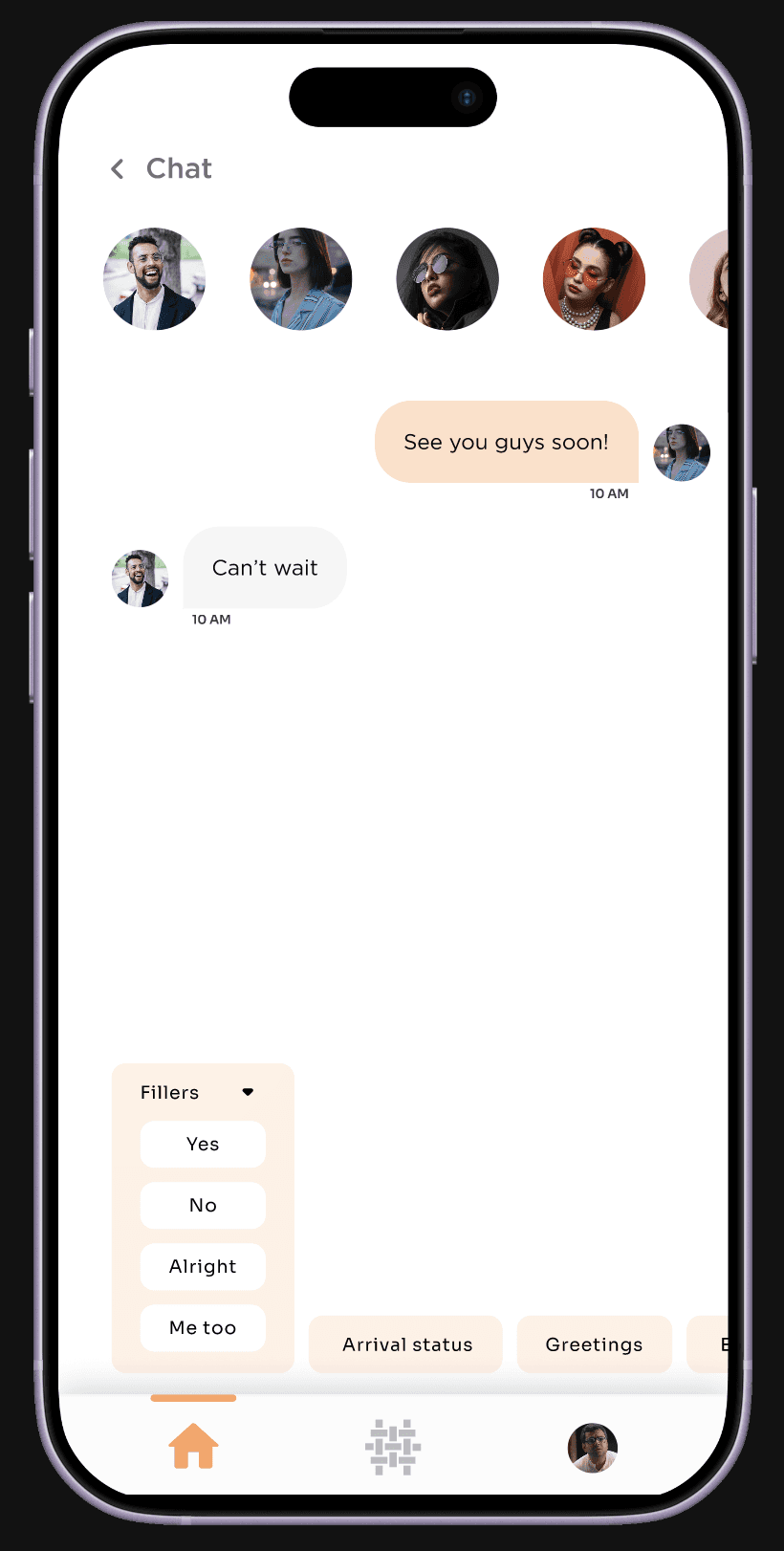
Group chat and in-event social coordination layer
Profile screen and tiered subscription plans
Full design system — component library, type scale, colour tokens, and brand guidelines
Motivation
The brief for Weave came from a clear gap in the market, but the motivation behind taking it on was more personal. India's metros are full of young people — students, first-jobbers, people who've just moved cities — who are technically surrounded by people but functionally alone. Existing apps asked them to swipe through profiles in isolation and somehow turn that into a real human connection. That model was broken by design. The opportunity here was to build something that understood how people actually want to meet — around shared experiences, with the event as context and the app as infrastructure. Organising our own events to watch that dynamic play out in real life before drawing a single wireframe was not just a research method. It was a design principle: observe first, design second, never the other way around.
01 — Problem
What's the
problem?
The space between online and real life.
We are witnessing a quiet epidemic — not of disease, but of disconnection. Despite being the most digitally connected generation in history, Gen Z has been labelled the loneliest generation. Dating apps promised to fix this. Instead, they made it worse.
The problem isn't that people don't want to connect. It's that the tools we've built for connection are shallow by design — built for scrolling, not for meeting. Weave exists to change that.
02 — Research
Understanding
the space
Exploring loneliness
and digital dating.
We began by looking at research on urban loneliness, Gen Z social behaviour, and the psychology behind why dating apps are failing. We studied how young people in Indian metros — Bengaluru, Mumbai, Delhi — use their phones to socialise, and what drives or kills engagement on existing platforms.
From here, we spoke directly to people who had recently moved to new cities, looking for connection. We also conducted a user survey to understand how people currently experience dating apps and what they actually want from them.
App burnout
Over 79% of Gen Z report feeling burnt out by traditional dating apps like Tinder, Hinge, and Bumble.
Loneliness epidemic
80% of Gen Z felt lonely in the past year — more than any other generation surveyed globally.
Growing urban population
India's metro cities are seeing an unprecedented influx of young professionals and students moving away from home.
Anxiety about meeting IRL
70% of Gen Z report anxiety about meeting people in real life, making low-pressure group settings essential.
Boredom with existing apps
Young Indians aged 16–24 cite boredom as their top reason for quitting dating apps — the format no longer excites them.
The newcomer problem
Young people who migrate to big cities often find themselves without any existing social network to fall back on.
03 — Landscape
The rise of
dating apps
How swiping became
the norm — and why it's failing.
Apps like Tinder, Bumble, and Hinge fundamentally changed how people meet. They made it fast, accessible, and low-effort. But that same low-effort design is now their greatest weakness.
Swiping based on a photo and a bio creates shallow first impressions. Conversations go nowhere. Ghosting is expected. And the people who most need real connection — those new to a city, those who are introverted, those who are simply tired of performing online — are left behind.
Casual intent
Serious relationships
Friendship
UNDERSERVED
Shared experiences
MISSING
Community
MISSING
04 — Analysis
Mapping the
landscape
What exists, and
where it falls short.
We analysed the three dominant players — Tinder, Bumble, and Hinge — to understand exactly what gap Weave is designed to fill. Each app does something well. But none of them solve the core problem: getting people into the same room.
Even Hinge, which recently began funding real-world social events through its One More Hour initiative, treats events as an add-on. For Weave, events are the product.
Tinder
The volume play. 75 million monthly active users, built for casual swiping. Great for reach — not for depth or genuine connection.

Bumble
The safety play. Women message first, reducing unwanted contact. But it still relies on the swipe-and-match formula with no group or event layer.

Hinge
The relationship play. Prompt-based profiles go deeper than photos alone. But it remains a 1:1 model with no infrastructure for group meetups or shared experiences.
05 — Interviews
Deeper understanding
through conversations
Talking to real people
in real cities.
We had informal conversations with young professionals and students across Bengaluru — people who had recently relocated and were navigating the challenge of building a social life from scratch.
These conversations surfaced a pattern that no data set could fully capture: people weren't just looking for a romantic partner. They were looking for their people — the friends, the crew, the familiar faces in an unfamiliar city.
No shared context
Meeting strangers online feels hollow without something in common. A shared event, interest, or activity changes everything.
Groups reduce pressure
Not everyone is ready for a one-on-one date. Group settings lower the social stakes and make first meetings far less intimidating.
Safety as a dealbreaker
For women especially, meeting someone from an app in person carries real risk. Trust and verification aren't optional features — they're the foundation.
Cities feel lonely
The irony of a big city is that the more people around you, the more isolated you can feel. Finding your niche in a new place takes time most people don't have.
06 — Survey
Understanding
sentiments
Perception of connection
and community.
To gauge how people feel about dating apps and real-world socialising, we surveyed young adults between the ages of 18 and 30 across metro cities in India. Respondents came from diverse backgrounds and lifestyles, giving us a well-rounded picture of how Gen Z actually wants to connect.
All respondents were between the ages of 18 and 30, with the majority being students and early-career professionals who had moved cities in the last two years.
Current apps
Satisfaction
Hesitation
Events
Safety
Willingness
Which dating apps do you currently use?
Multiple choice — respondents could select all that apply.
Tinder
68%
Hinge
45%
Bumble
33%
None
22%
Wrapping up
the study
Key observations
and takeaways.
The study revealed that while most participants had tried at least one dating app, few felt they had made a meaningful connection through it. Group events were consistently seen as a lower-stakes, more natural way to meet people.
Price and accessibility were flagged as key factors — affordable or free events could significantly lower the barrier to participation. Safety and verified profiles were non-negotiable, particularly among women. And over 60% expressed strong interest in an app that combined matching with real-world experiences.
07 — Goals
Final goals
of the app
What Weave is
ultimately designed to do.
Find your people
Weave helps you discover both romantic connections and genuine friendships — because sometimes what you need isn't a date, it's your crew.
Events as the introduction
Treks, open mics, food trails, and game nights replace the awkward first message. Let shared experiences do the talking.
Privacy and security
Built with verified profiles, in-app safety tools, and transparent data practices — because trust is the foundation of any real connection.
Real-time social matching
Weave integrates event attendance and shared interests into its matching algorithm — so you meet people you'd actually get along with.
Bridging dating and friendship
Weave removes the pressure of a label. Whether you're looking for a partner or just a solid group of friends, the app works for both.
Lowering barriers
Affordable, interest-based events curated to your city and vibe — so showing up feels exciting, not terrifying.
Visual Identity
Built to feel
warm & inviting.
A system rooted in
warmth and trust.
Soft Peach
FFD4A8
Pure White
FFFFFF
Weave Orange
FEA462
Deep Tangerine
FF7B3F
Gotham
Display · UI · Labels
Poppins
Body · Descriptions · Captions
Process
Information
Architecture
How users move through Weave — from first launch to booking an event and meeting their matched group.
Weave
Login & Onboarding
Home
Booking
Group match
Chat Screen
Event detail
Match
Profile
Plans
Settings
Swipe
Wireframes
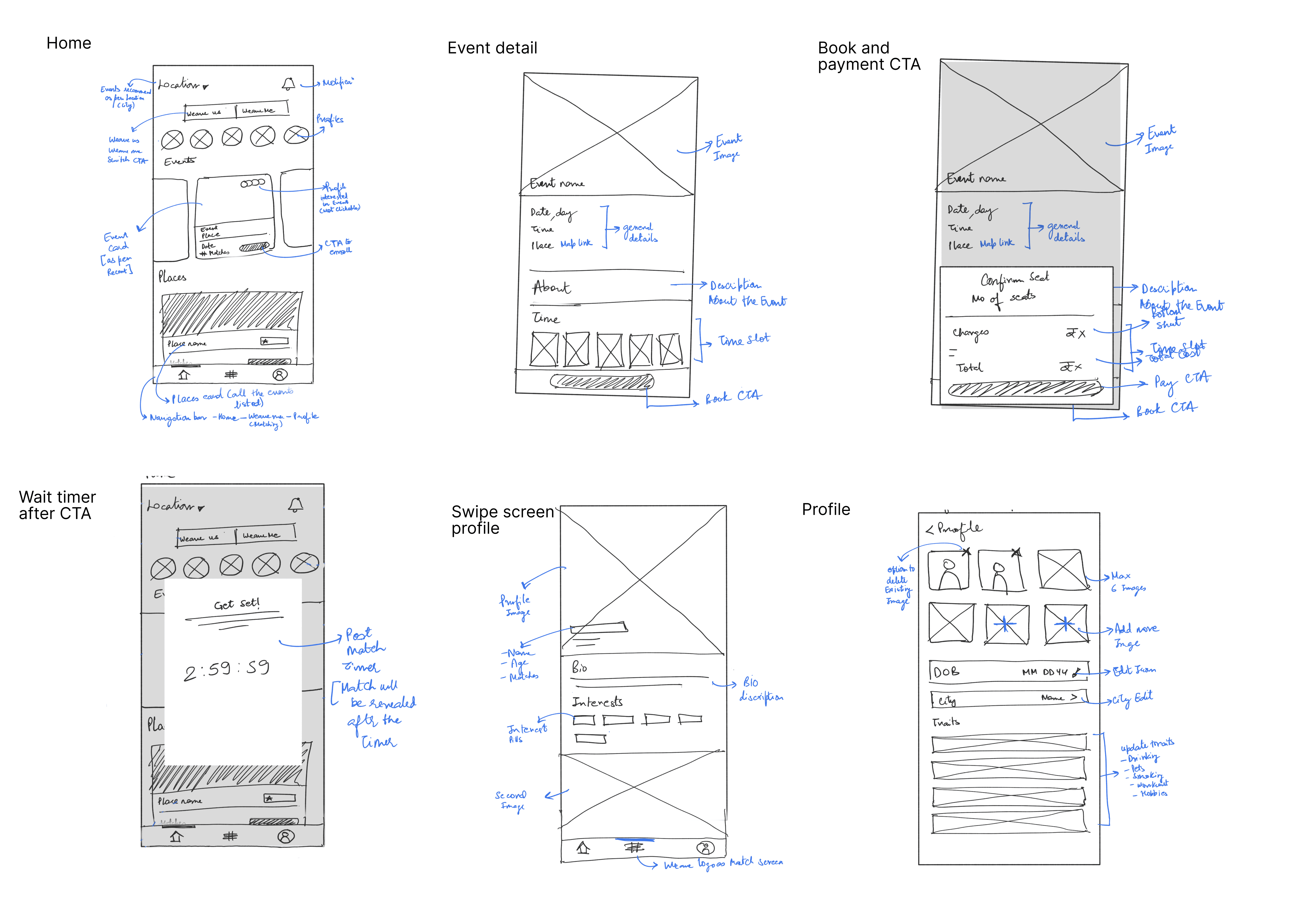
Low-fidelity screens mapping the core journeys before visual design began.
Wireframes were produced for every core flow — onboarding, home, event discovery, booking, group reveal, and matching. Each screen was iterated on in low fidelity to validate hierarchy, navigation logic, and content priority before any visual decisions were made.
Replace each placeholder below with the corresponding wireframe image. Recommended format: PNG or JPG, portrait orientation (9:16 ratio).
The final
designs.
Built for warmth,
clarity, and real connection.
The interface was designed in adherence to iOS Human Interface Guidelines, ensuring that every interaction pattern — navigation structure, gesture behaviour, typography scale, and component spacing — feels native and expected to users on Apple devices.
Visually, Weave leads with warmth. A consistent orange palette, rounded components, and deliberate use of negative space were applied to communicate approachability at every touchpoint. The design system was built to carry that tone across all screens without exception, from the onboarding flow to the group chat.
Splash screen
The splash screen establishes Weave’s visual identity while guiding users toward the primary actions — logging in or creating a new account. A warm illustration introduces the community-focused nature of the platform, while the minimal layout keeps attention on the core entry points. The screen also reinforces trust by surfacing the Terms of Service and Privacy Policy upfront, helping users feel informed before continuing.


Onboarding
The sign-up flow collects the information required to power Weave's matching algorithm — a verified mobile number confirmed via OTP, profile photos, display name, date of birth, and gender. Each step is scoped to a single input to reduce friction and drop-off. The resulting profile is lightweight but sufficient for contextual matching from the user's first session.
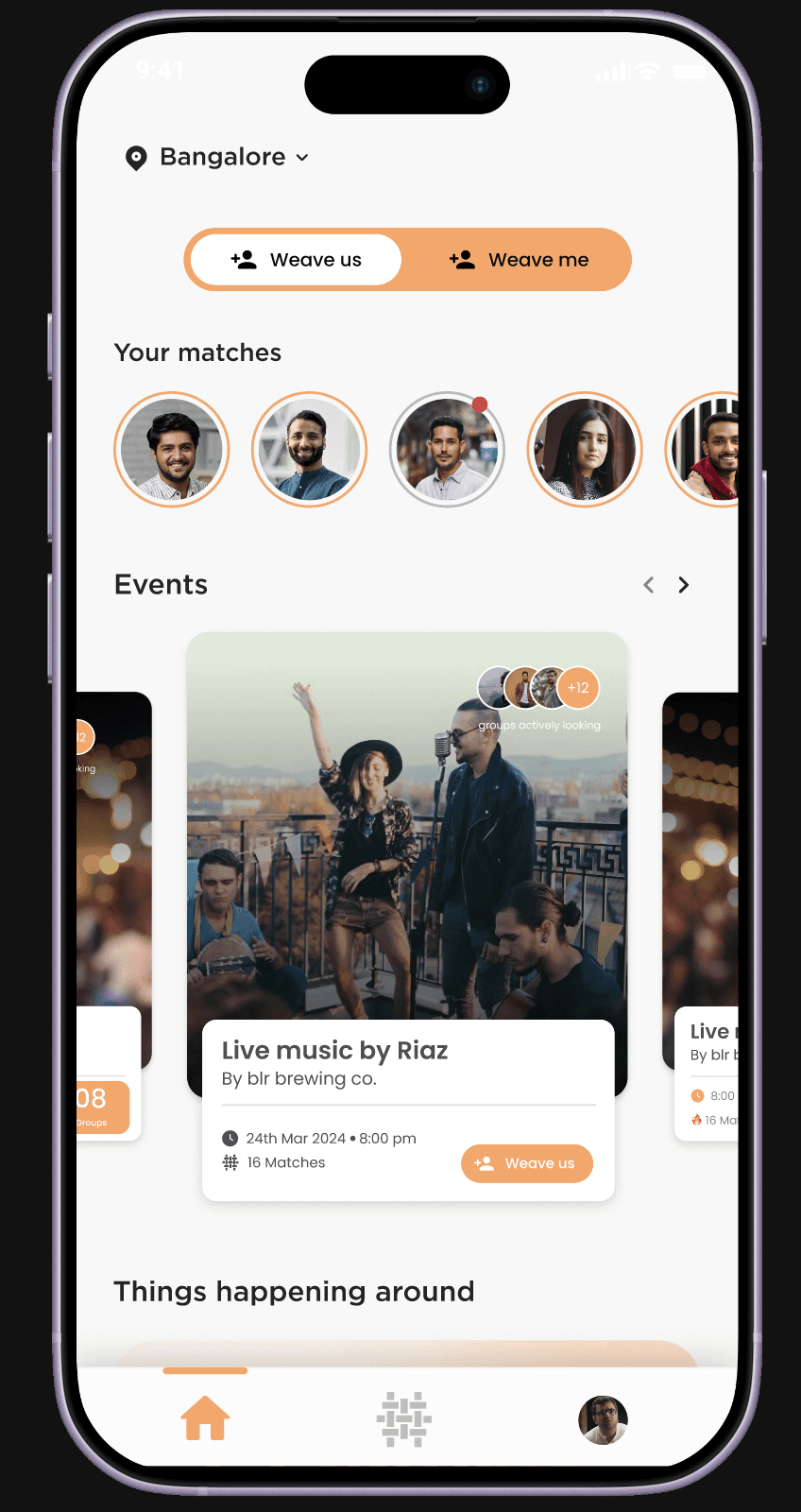
Home Screen
The home screen surfaces nearby events in real time, sorted by proximity and relevance to the user's declared interests. Each event card displays the venue, category, date, and the number of Weave users already registered to attend. A fixed bottom navigation bar provides access to the three core sections — Home, Match, and Profile — establishing a consistent structural hierarchy across the app.
Event Detail
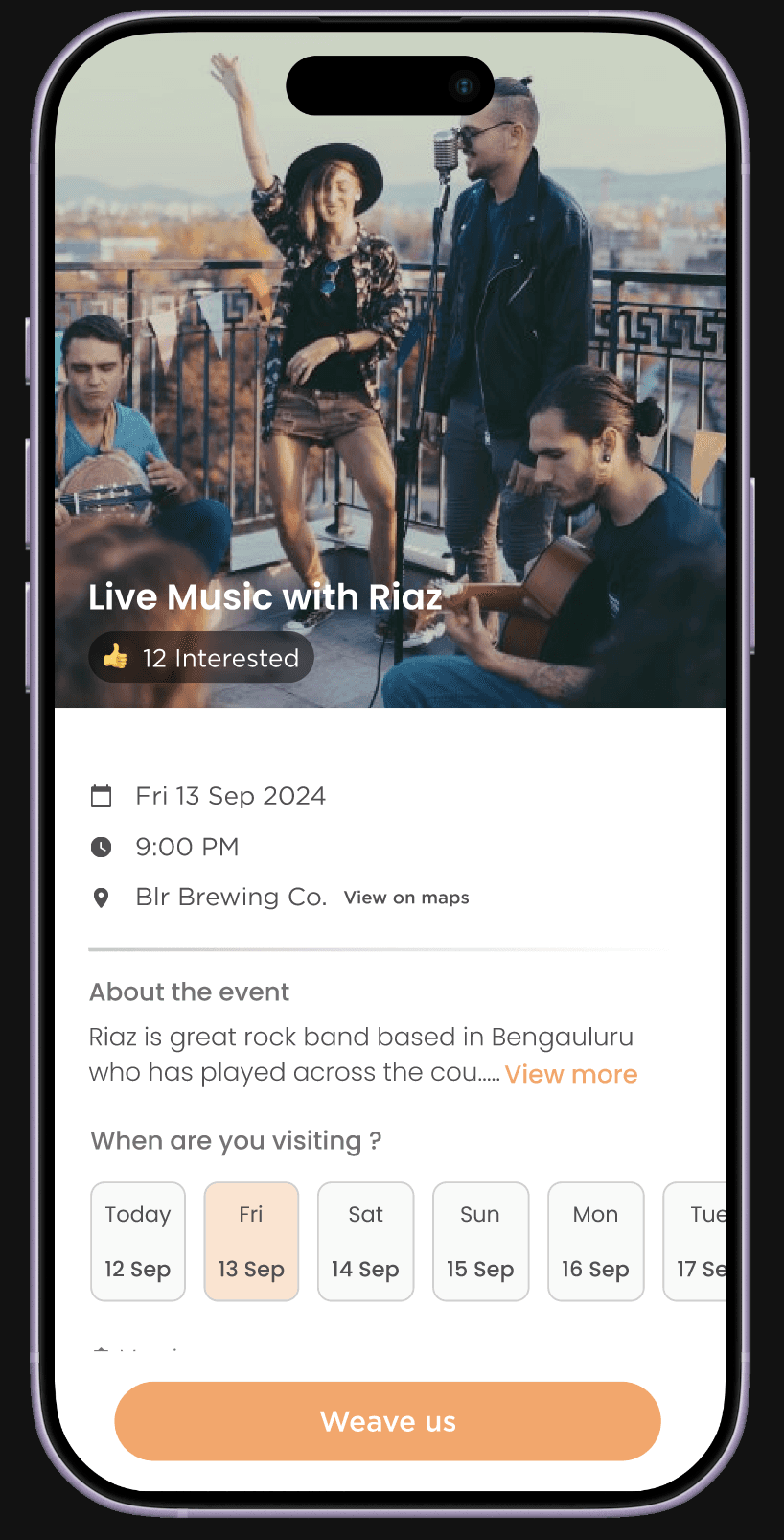
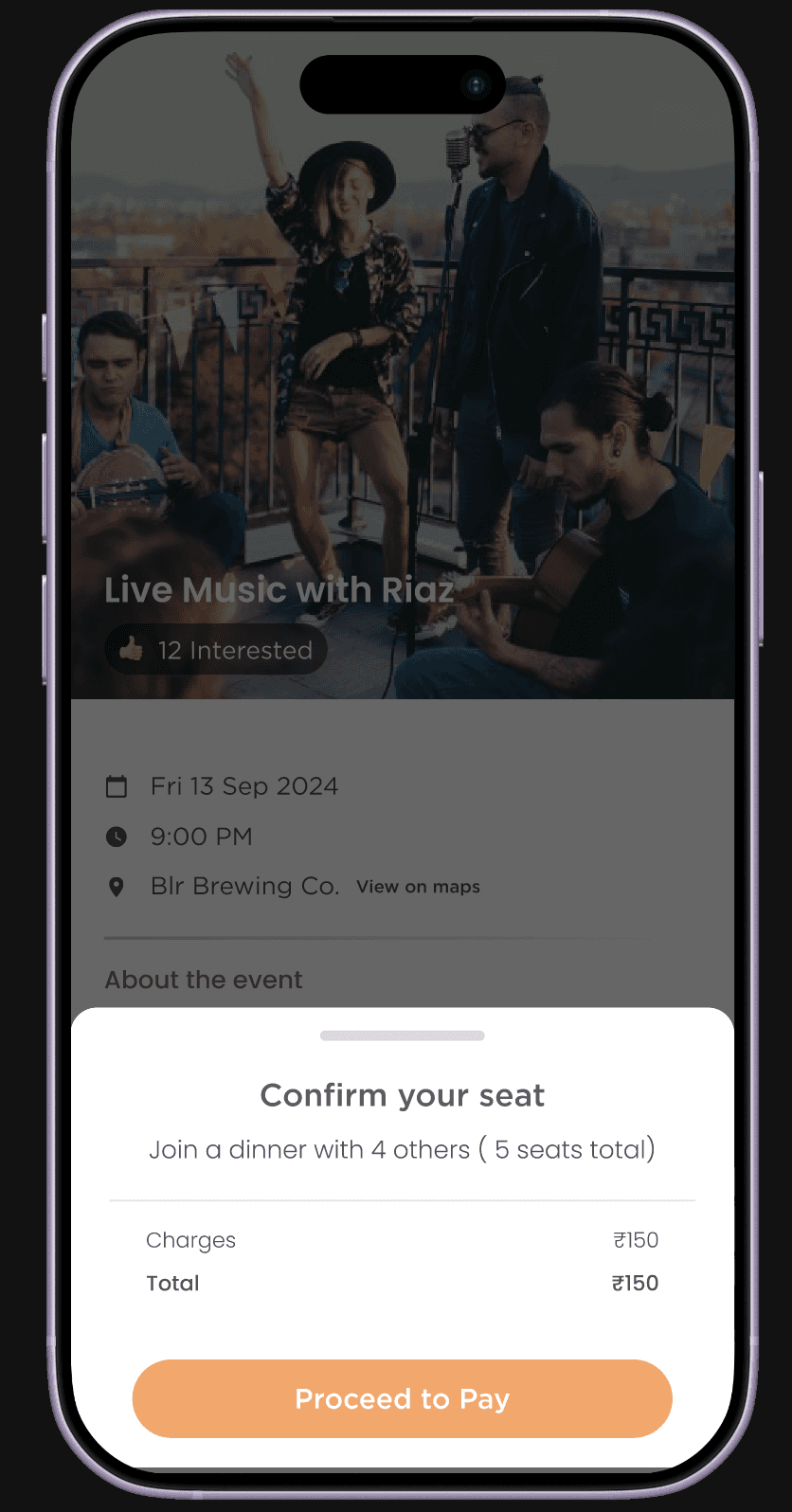
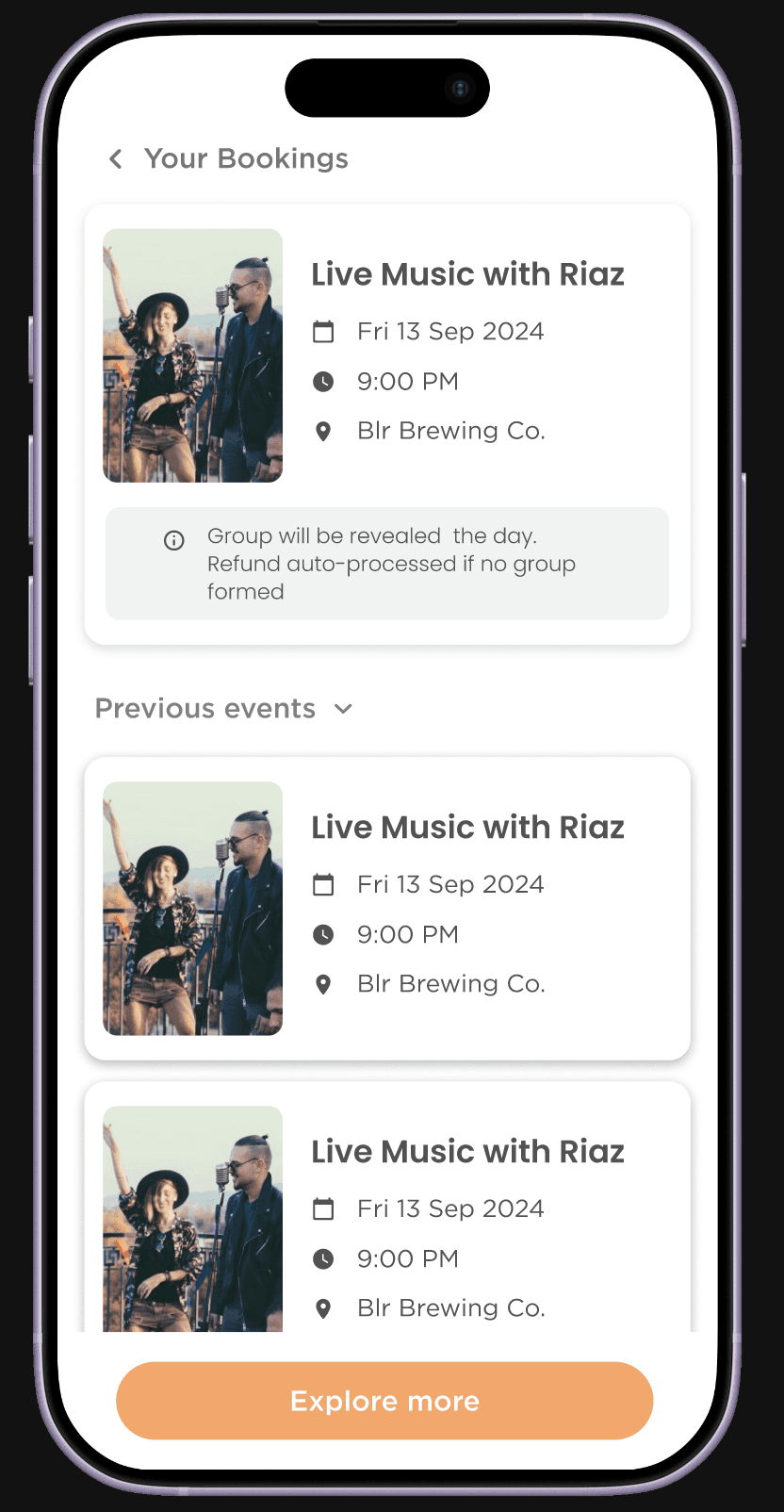
Tapping an event opens a detailed view containing the full event description, venue address, date and time, and programme or lineup where applicable. Users can view aggregated ratings and community reviews from past attendees, as well as the number of other Weave members who have expressed interest. A booking action is surfaced prominently once the user has reviewed the event information.
Group Matching
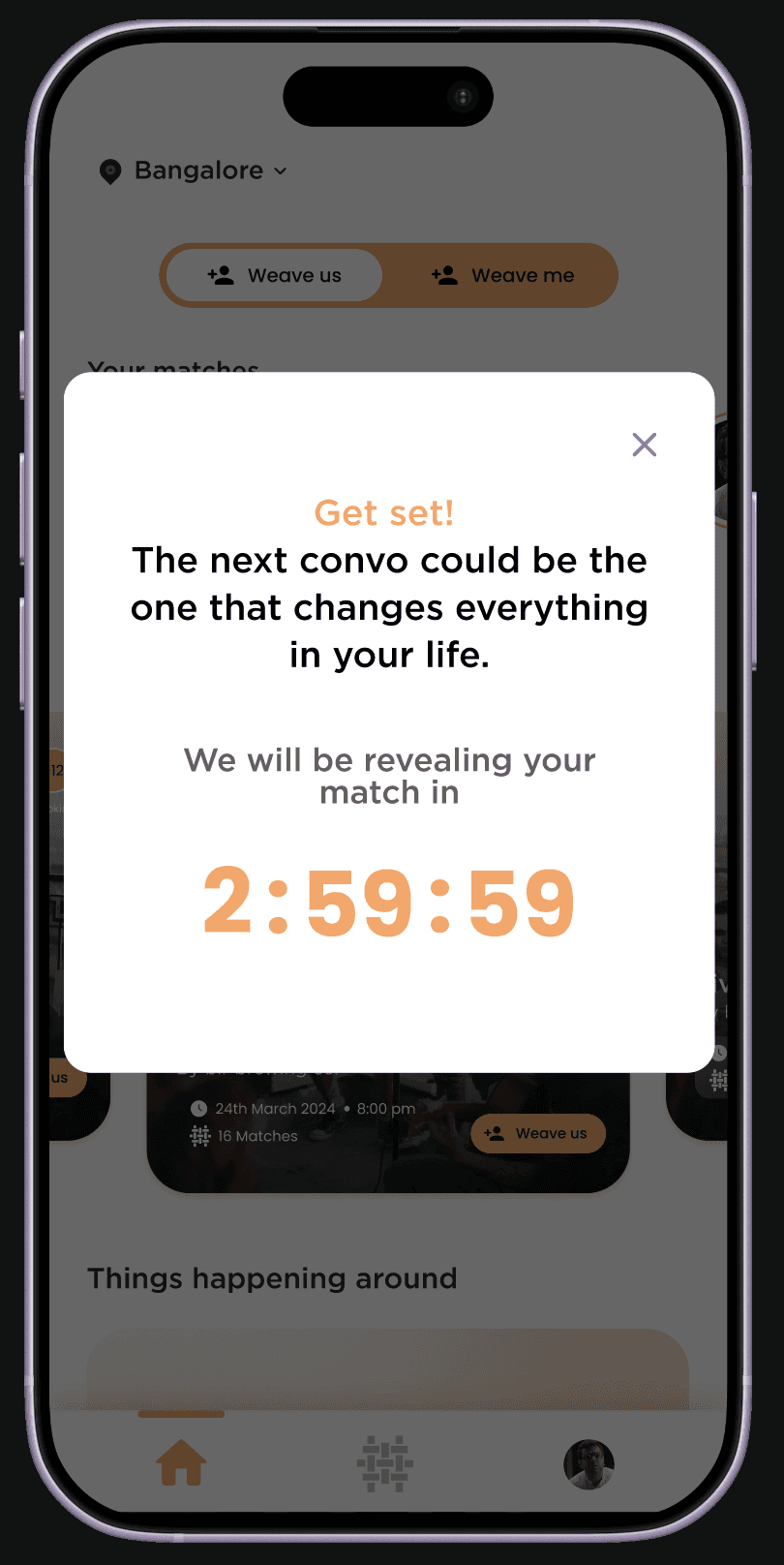
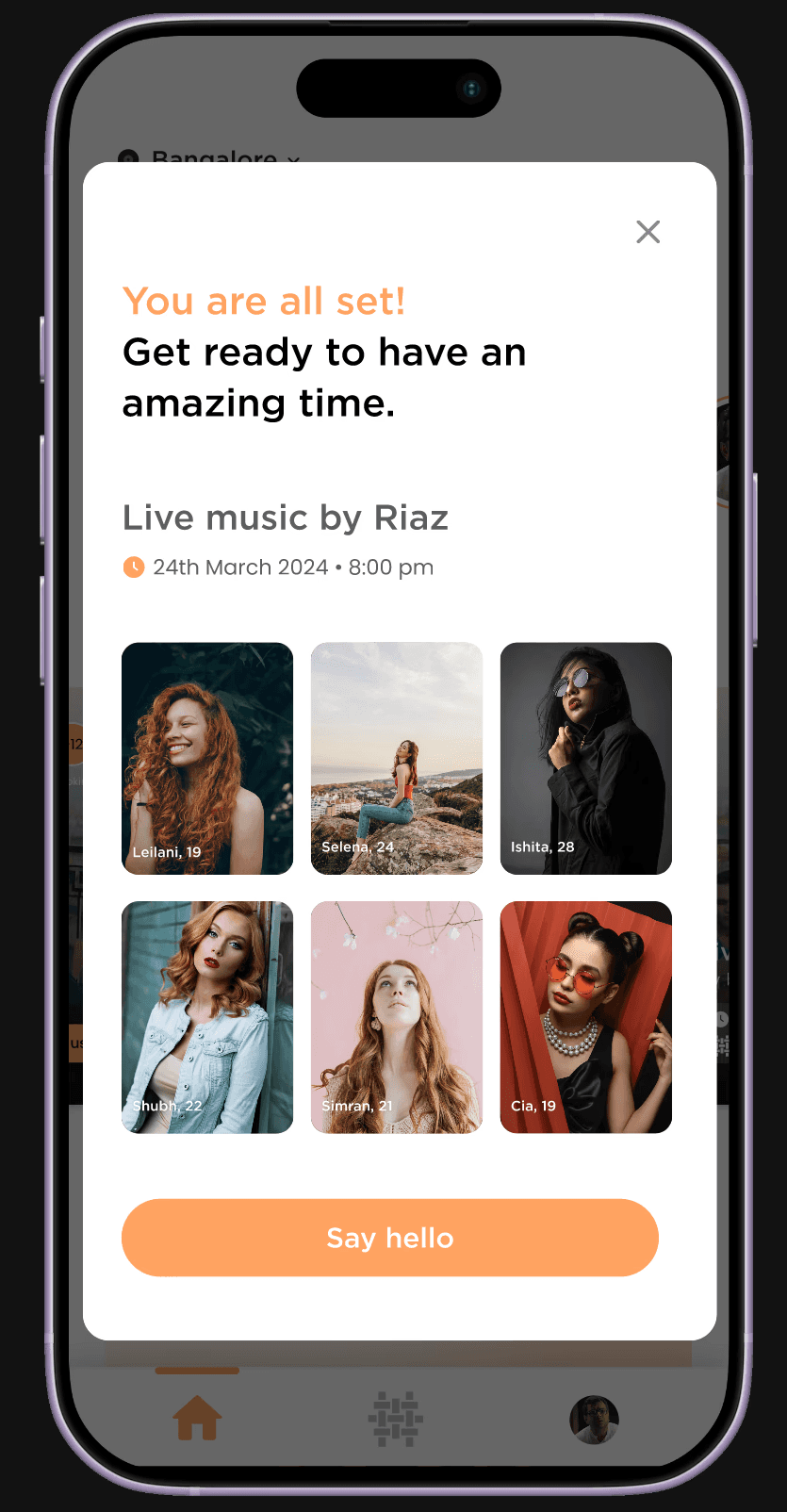
The group matching flow introduces users to people attending the same event, making it easier to start conversations before meeting in person. Once a match is created, users receive a lightweight confirmation screen that encourages them to say hello and break the ice. For event-based groups, the interface highlights the event details, date, and fellow attendees, giving users enough context to connect confidently while keeping the experience simple and low-friction.
Individual match screen
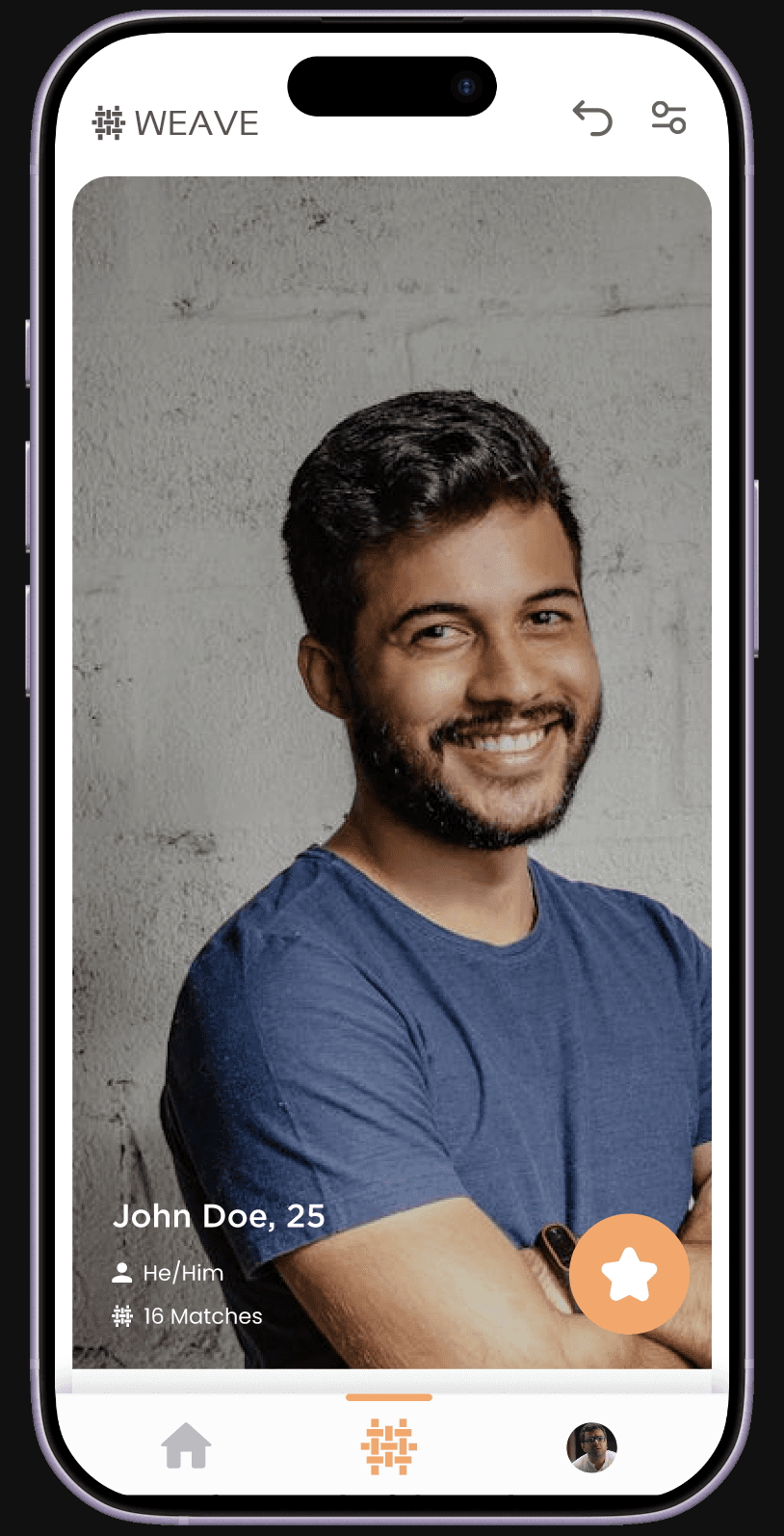
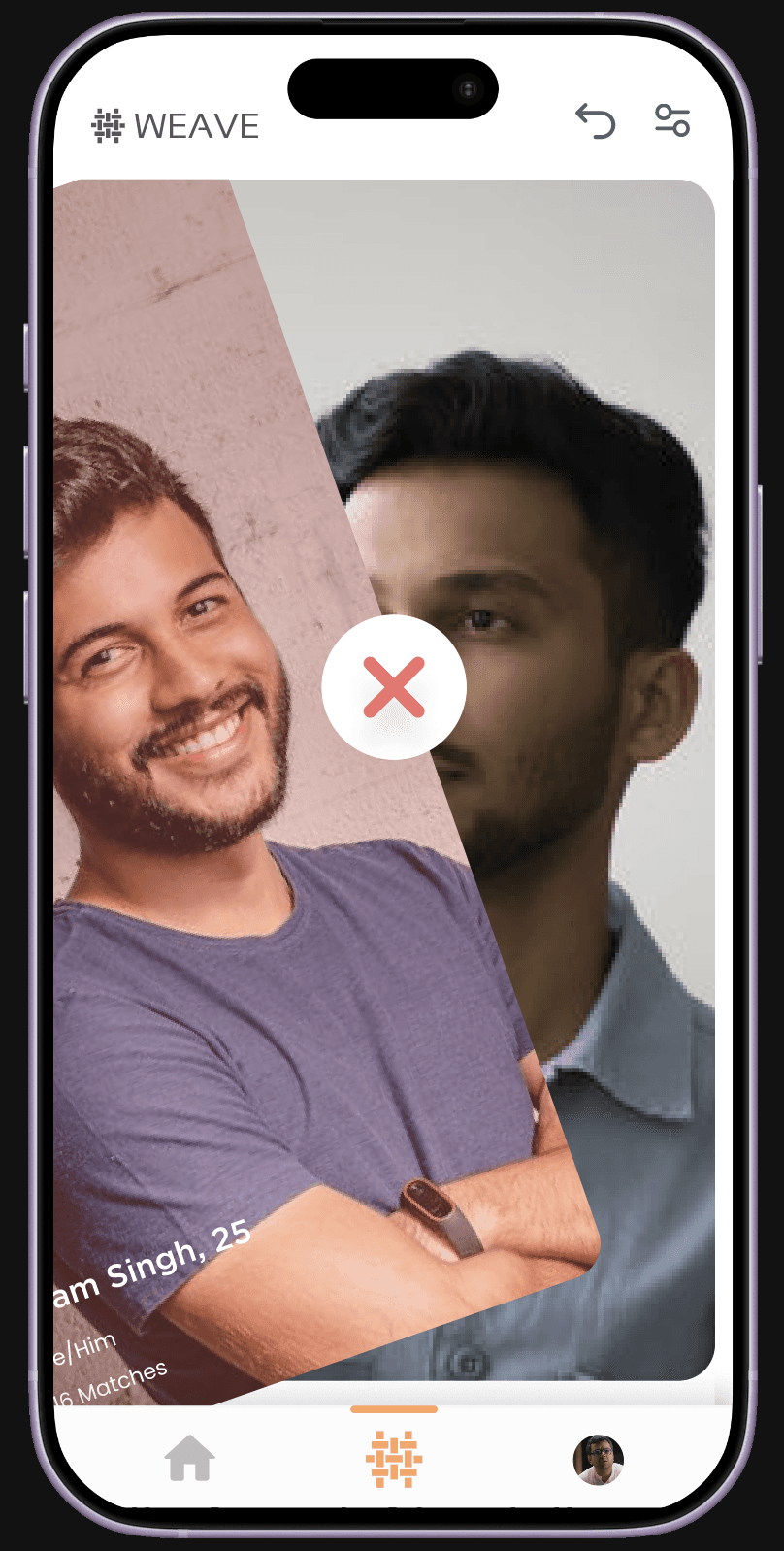
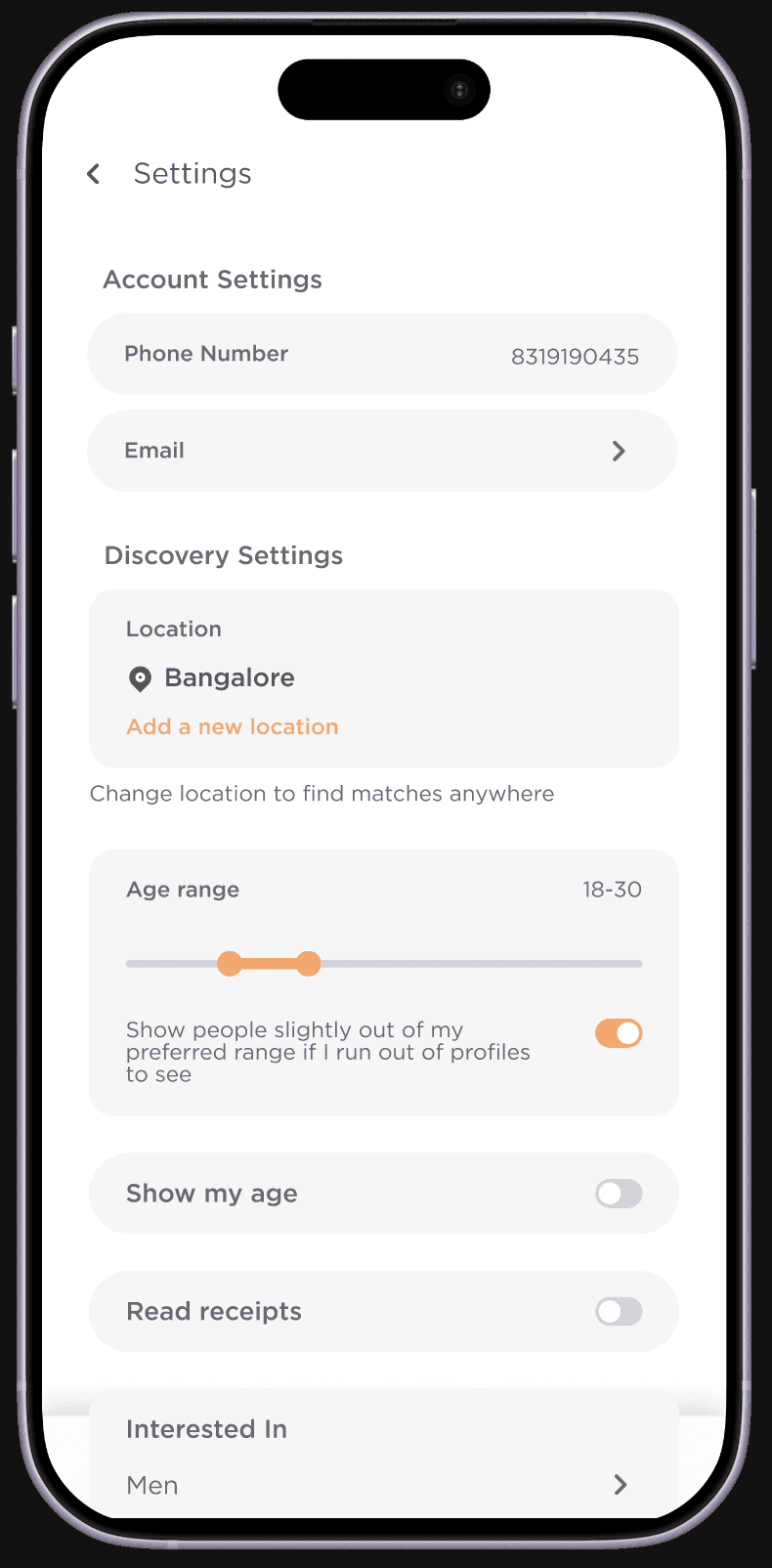
The match screen presents profiles of other users attending the same event, filtered by compatibility signals including shared interests, age range, and group-size preference. Users can swipe to express interest or pass. Mutual matches are only revealed when both parties have indicated interest, maintaining a consent-first interaction model. Additional match settings allow users to adjust filters and toggle between solo and group matching modes.
Reflections
What we
learned.
Some thoughts from
a 4-month deep dive.
This sprint revealed the opportunity to build Weave into more than just an event discovery platform—it can become a social layer around real-world experiences. The current version successfully creates low-friction ways for users to discover events, match with groups, and start conversations before attending. Looking ahead, features like stronger interest-based recommendations, richer attendee profiles, and post-event connections could make the experience feel even more personal and lasting. Group chat spaces, safety tools, and smarter matching based on intent or vibe could further strengthen trust and compatibility. Over time, Weave has the potential to evolve from a one-time event companion into a platform that helps people build meaningful, real-life communities.